
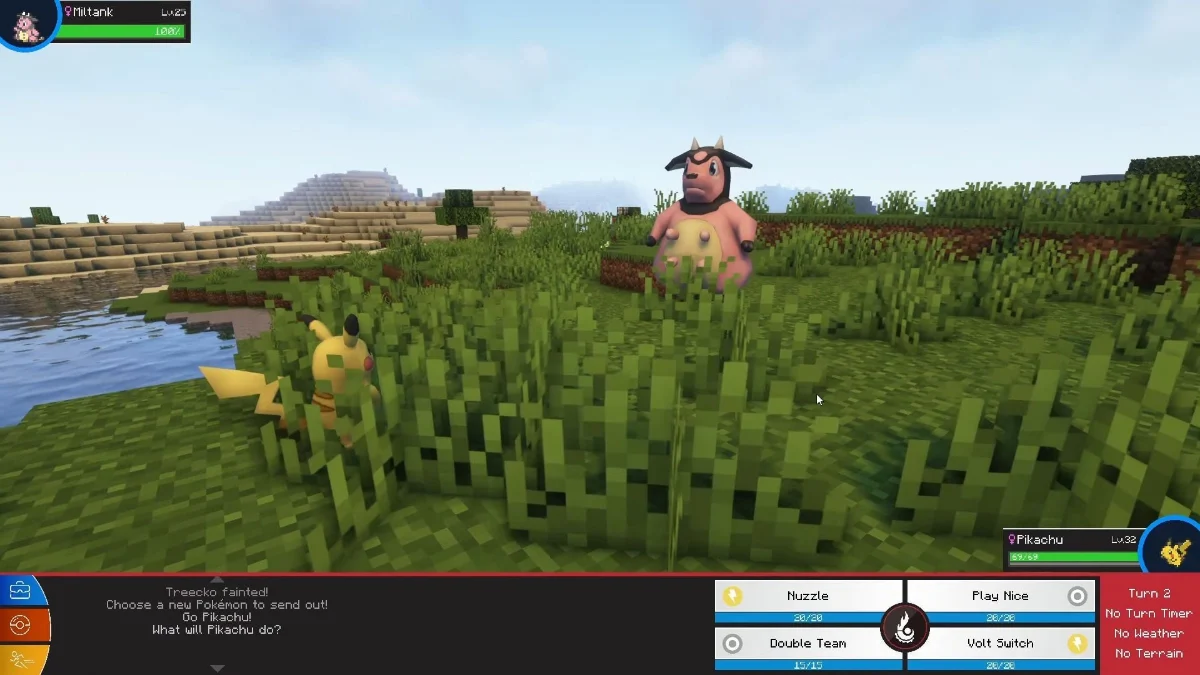
Pixelmon battle screenshot; interface appearance varies by release. Image: Gameplay image via Sportskeeda.
Pixelmon evolution is not a single rule that applies to every Pokemon. Some evolutions are connected to leveling, while others involve items or additional conditions. The useful starting point is the exact Pokemon and the form you want, followed by a check of the relevant reference for your installed release. This guide helps you turn that information into a practical plan and diagnose a missing evolution without wasting supplies or abandoning a favorite teammate.
Identify the exact Pokemon first
Open the Pokemon's summary and confirm its species and form. Similar appearances or related names can hide differences that matter when looking up evolution requirements. If you are using a nickname, search for the underlying species rather than the nickname. Record the current level and any held item so that you have a clear starting point.
Next identify the result you want. Some evolutionary lines branch, so searching only for a general family name can lead to instructions for a different outcome. Write the intended before-and-after pair in your notes. That simple step prevents you from gathering the correct item for an evolution you did not actually intend to choose.
Read the complete requirement
The official evolution reference explains that evolution can alter appearance, base statistics, available moves and sometimes typing. It also describes several trigger categories. Use the general page to understand the method, then consult the species entry for the actual requirement. Avoid assuming that a familiar method from another Pokemon game is identical in your installed Pixelmon release.
Read the whole condition, including any qualifying text. A level requirement may be only one part of a larger rule. An item may need to be used directly rather than held, or a separate event may need to happen afterward. Treat each part as a checklist item instead of picking the one detail that seems easiest to remember.
Distinguish a condition from a trigger
A condition describes a state that must be true, while a trigger is the event that causes the game to check for the evolution. Confusing them can make a working mechanic look broken. Reaching a threshold and then waiting in place may not reproduce a process that is checked during a later level-up or another specific interaction.
Before testing, write down both pieces in plain language: what must already be true, and what you need to do next. Then make one controlled attempt. If nothing happens, compare the result with the reference rather than immediately adding more items or changing several conditions. A repeatable attempt gives you better evidence than a sequence of unrelated guesses.
Plan around moves and your team
Evolution should serve the way you want to use the Pokemon. Check the moves you currently rely on and the role the evolved form will fill. A different type or different set of options may change how the team handles familiar opponents. Do not assume that a visual transformation automatically solves every weakness you noticed in battle.
If a particular move matters to your plan, consult the species information before using a limited evolution item. Compare the earlier and later forms rather than relying on a general rule about evolving as soon as possible. You can also choose to keep a favorite form for collection or casual exploration. Your own goal determines which tradeoffs matter.
Prepare item-based attempts carefully
Verify the exact item name and the way the reference says to use it. Similar names, decorative items or objects added by other mods are not necessarily interchangeable. Keep only the supplies needed for the attempt in easy-to-reach inventory spaces so that you can recognize what changed afterward. Store spare valuables before experimenting on an unfamiliar interface.
If the intended item has no effect, pause before repeating the action. Confirm the species, the target and the interaction method. Check whether the game gave a message or whether the item remained in your inventory. Recording those observations helps distinguish an incorrect requirement from a missed interaction or an item that belongs to another part of the process.
Handle time and other context deliberately
Some evolution methods involve additional context, such as time-related requirements. Check the specific species information and avoid treating real-world clock time as the same thing as the Minecraft world's state. Multiplayer environments may also apply settings or custom behavior that affect what you see. Ask for the server's documented rules when the ordinary reference does not explain the result.
Make the test easy to interpret. Keep your Pokemon and supplies ready, confirm the required context and perform the documented trigger. Note the result and the conditions you observed. If you keep changing location, items and party order together, it becomes difficult to know which factor mattered when the evolution eventually succeeds.
Check prevention before assuming a bug
Look through the Pokemon's held items and any messages shown during the attempt. The official reference identifies Everstone as an item that can prevent evolution and describes cancelling an evolution. Those are reasons to inspect the current state before spending time reinstalling the mod. Check the actual item rather than relying on what you remember giving the Pokemon earlier.
If you deliberately stopped an evolution, consult the relevant method to determine how to try again. Avoid interpreting one cancelled attempt as permanent damage to the Pokemon. Keep your investigation focused: confirm the requirement, check for prevention and repeat the correct trigger. Only then consider whether you need help investigating a release-specific problem.
Be careful with trades and shared worlds
When a method involves another player, arrange the process clearly before handing over a valued Pokemon. Confirm the intended action, any return arrangement and the server's trade rules. Use the community's supported trading interface where available. An evolution goal should not depend on trusting an unexplained request from a stranger who promises a shortcut.
On a private world, agree with friends about whether administrative commands are part of normal progression. Using a command to skip a requirement changes the experience and may hide a misunderstanding that will affect future attempts. If you are testing a mechanic as an administrator, use a disposable example and keep that experiment separate from another player's collection.
Gather useful evidence if it still fails
Record the installed Minecraft and Pixelmon versions, exact species and form, current level, held item and the requirement you tried to satisfy. Include any message the game displayed. If a server is involved, state that clearly because custom settings or additions may be relevant. A short, precise report gives helpers a better starting point than saying only that evolution is broken.
Before making installation changes, preserve a backup of a local save. Compare the behavior in a separate test world if you know how to reproduce the same conditions. Keep the original profile available while testing. Avoid downloading unrelated fixes or repeatedly updating the whole pack before you have established whether the issue is a misunderstood requirement.
Keep an evolution plan you can verify
A useful evolution note has five parts: the starting species, the desired result, the documented conditions, the trigger and the observed outcome. Add the reference link and installed release. This small record is especially helpful when several party members need different methods. You can gather supplies for each goal without confusing one Pokemon's requirement with another member of the same family.
Suppose your reference describes a method involving an additional condition at level-up. Your note should separate preparing that condition from gaining the next level. After the attempt, record whether the expected event occurred and whether the game displayed a message. You do not need a complicated spreadsheet; a few clear sentences can reveal a missing step that repeated trial and error concealed.
Update the note when you learn something new, but distinguish a confirmed requirement from an explanation you are still testing. One failed attempt does not establish a new rule about a species. If a server administrator confirms custom behavior, record that as a server-specific detail. The same notes can then help a friend without presenting your world's settings as universal mechanics.
Review the team after a successful evolution
Once the evolution succeeds, inspect the Pokemon before returning to a difficult challenge. Review its current moves and its place in the party. Try a familiar route so that you can recognize what changed without also learning a new opponent. If the result differs from your expectation, revisit the species reference and your original goal. A successful evolution is a useful milestone, but understanding the resulting teammate is what turns that milestone into better decisions during the next adventure.
FAQs
Does every Pokemon evolve by leveling up?
Can a held item stop an evolution?
Should I evolve every Pokemon immediately?
Conclusion
Plan Pixelmon evolution around the exact species, desired result and complete requirement. Separate the conditions from the trigger, inspect held items and make controlled attempts. When something fails, gather specific evidence before changing the installation. That approach protects your resources and makes your team's next step easier to understand.
Reference: Official Pixelmon evolution reference. Check the documentation for your installed release; interfaces and server settings can differ.